

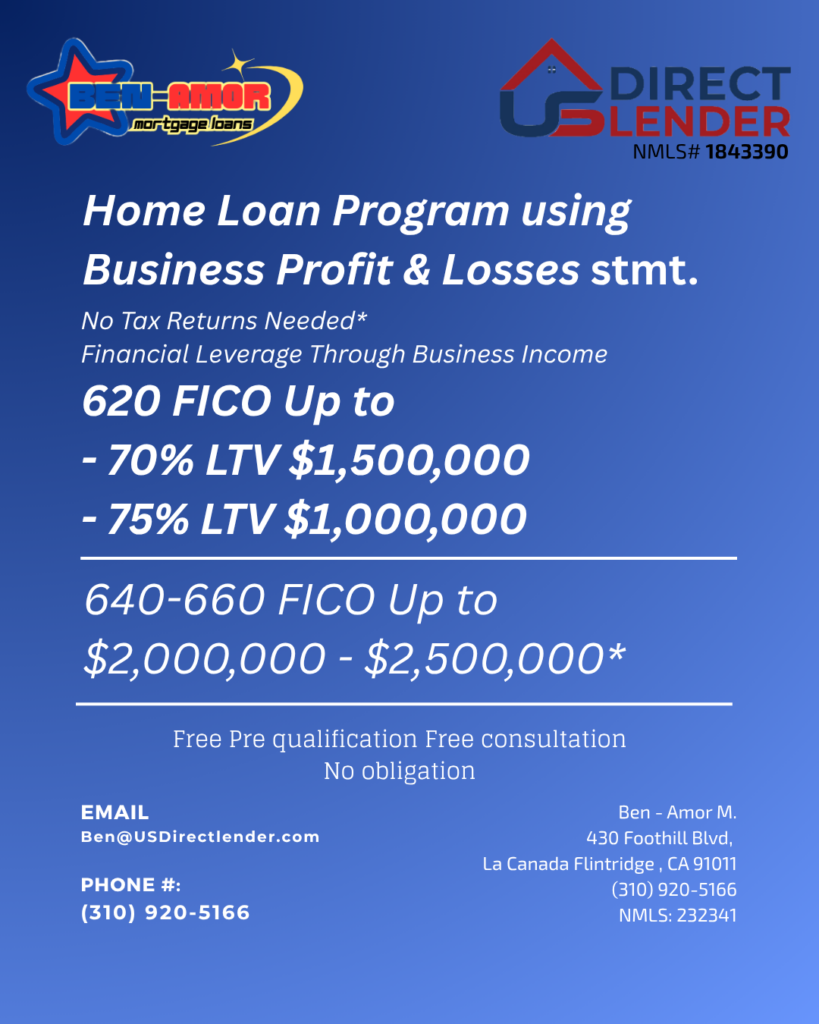
Home Loan Program: Using Business Profit & Losses
Understanding Profit & Loss Statements for Mortgage Qualification
For many self-employed borrowers, qualifying for a mortgage can feel more complicated than it does for traditional W-2 employees. Business owners often take advantage of legitimate tax deductions to reduce taxable income, but those deductions can sometimes make it appear that they earn less than they actually do. This is where a Profit & Loss (P&L) Statement becomes an important financial document.
A Profit & Loss Statement provides a snapshot of a business’s financial performance by showing income, expenses, and net profit over a specific period. Mortgage lenders may use this document to gain a clearer understanding of a self-employed borrower’s financial situation when evaluating loan eligibility.
What Is a Profit & Loss Statement?
A Profit & Loss Statement, often called a P&L, is a financial report that summarizes a business’s revenues and expenses during a specific timeframe, such as monthly, quarterly, or annually.
The purpose of the report is simple: it shows whether a business made money or lost money.
The basic formula is:
Revenue – Expenses = Net Profit (or Loss)
For example:
- Gross Revenue: $250,000
- Business Expenses: $100,000
- Net Profit: $150,000
In this scenario, the business generated $150,000 in profit after all expenses were paid.
Why Mortgage Lenders Review P&L Statements
Traditional mortgage programs often rely heavily on tax returns to calculate income. However, self-employed borrowers frequently write off expenses that reduce their taxable income.
While these deductions help lower taxes, they can also reduce qualifying income for mortgage purposes.
A Profit & Loss Statement helps lenders evaluate:
- Current business performance
- Revenue trends
- Stability of income
- Business profitability
- Ability to repay a mortgage
In some loan programs, a P&L Statement may be used alongside bank statements, tax returns, or other business documentation to provide a more complete financial picture.
Who Typically Uses a P&L Statement?
Profit & Loss Statements are commonly used by:
- Business owners
- Independent contractors
- Consultants
- Freelancers
- Gig workers
- Real estate agents
- Truck drivers
- Construction contractors
- Medical professionals with private practices
- Sales professionals paid on commission
Anyone who receives income through self-employment rather than a traditional paycheck may need to provide a P&L Statement during the mortgage process.
What Information Is Included in a P&L Statement?
A standard Profit & Loss Statement generally contains several key sections.
Revenue
This section shows all income generated by the business.
Examples include:
- Sales revenue
- Service income
- Commission income
- Contract payments
- Professional fees
Cost of Goods Sold (If Applicable)
Businesses that sell products may report costs associated with producing or purchasing those products.
Examples include:
- Inventory costs
- Manufacturing costs
- Wholesale purchases
Operating Expenses
These are the costs of running the business.
Common expenses include:
- Rent
- Utilities
- Insurance
- Advertising
- Payroll
- Vehicle expenses
- Office supplies
- Professional services
Net Profit
After subtracting expenses from revenue, the remaining amount is the net profit.
This figure often receives significant attention from mortgage lenders because it helps demonstrate the borrower’s income-producing ability.
Example of a P&L Statement
Imagine a self-employed graphic designer who earned $12,000 per month.
Monthly Revenue:
- $12,000
Monthly Expenses:
- Office Rent: $500
- Software Subscriptions: $200
- Marketing: $300
- Internet & Utilities: $200
- Miscellaneous Expenses: $300
Total Expenses:
- $1,500
Net Monthly Profit:
- $10,500
In this example, the business generated $10,500 in monthly profit that may be considered when evaluating mortgage qualification.
Benefits of Using a P&L Statement
Shows Current Income
Tax returns can be up to a year old. A current P&L Statement provides a more recent view of business performance.
Highlights Business Growth
If revenue has increased since the last tax filing, a P&L Statement may demonstrate positive growth trends.
Supports Self-Employed Borrowers
Many entrepreneurs have strong cash flow despite substantial tax deductions. A P&L Statement can help illustrate the true health of the business.
Provides Financial Transparency
Lenders appreciate documentation that clearly explains income and expenses.
Importance of Accuracy
A Profit & Loss Statement should always be accurate, consistent, and supported by documentation whenever possible.
Lenders may compare the information shown on a P&L Statement with:
- Business bank statements
- Tax returns
- CPA-prepared financials
- Year-to-date revenue reports
Discrepancies between documents can raise questions during underwriting.
Because of this, many borrowers choose to work with a Certified Public Accountant (CPA) or tax professional when preparing financial statements.
P&L Statements and Alternative Mortgage Programs
Profit & Loss Statements are particularly common among alternative documentation loan programs designed for self-employed borrowers.
These programs may be useful for borrowers who:
- Have significant tax write-offs
- Own multiple businesses
- Have variable income
- Recently experienced business growth
- Do not qualify using traditional tax-return calculations
Depending on the loan program, lenders may require a borrower-prepared P&L Statement, a CPA-prepared P&L Statement, or additional supporting documentation.
Final Thoughts
A Profit & Loss Statement is one of the most valuable financial tools available to self-employed borrowers. By clearly outlining revenue, expenses, and profitability, it helps lenders understand the financial strength of a business beyond what may appear on tax returns alone.
Whether you’re a business owner, independent contractor, consultant, or gig worker, maintaining accurate Profit & Loss Statements can improve financial organization and may help simplify the mortgage qualification process. For many self-employed borrowers, a well-prepared P&L Statement can be an important step toward achieving homeownership.


