

Small Business Owners Contractors Qualify
Understanding 1099 Income for Self-Employed Mortgage Borrowers
For millions of Americans, traditional W-2 employment is no longer the only path to earning a living. Independent contractors, freelancers, consultants, gig workers, and commission-based professionals often receive a Form 1099 instead of a paycheck from an employer. While self-employment offers flexibility and income potential, many borrowers believe qualifying for a mortgage is more difficult when they receive 1099 income.
The good news is that homeownership is absolutely possible for self-employed borrowers. Understanding how lenders evaluate 1099 income can help borrowers prepare for the mortgage process and identify the loan programs that best fit their situation.
What Is a 1099?
A Form 1099 is a tax document issued to individuals who earn income outside of traditional employment. Instead of receiving a W-2 from an employer, self-employed individuals typically receive one or more 1099 forms from clients or companies that paid them during the year.
Common professions that receive 1099 income include:
- Real estate agents
- Independent sales professionals
- Truck drivers
- Construction contractors
- Consultants
- Freelancers
- Rideshare drivers
- Delivery drivers
- Healthcare professionals
- Insurance agents
Because taxes are not automatically withheld from 1099 income, borrowers are considered self-employed in the eyes of most mortgage lenders.
Why Qualifying Can Be Different
Traditional mortgage borrowers often qualify using their gross W-2 income. Self-employed borrowers, however, frequently claim business deductions to reduce their taxable income. While these deductions may lower tax obligations, they can also reduce the income that appears on tax returns.
For example:
A W-2 employee earns $100,000 annually and reports $100,000 in income.
A self-employed contractor earns $100,000 but writes off vehicle expenses, equipment, fuel, office expenses, and other business costs. Their taxable income may appear closer to $65,000 or $70,000.
When lenders review tax returns, they often calculate income based on what remains after deductions, which can impact borrowing power.
How Mortgage Lenders View 1099 Income
Most conventional lenders require a history of self-employment and typically review:
- Personal tax returns
- Business tax returns (if applicable)
- Two years of income history
- Profit and loss statements
- Bank statements
Lenders look for consistency and stability. They want to determine whether the income is likely to continue into the future and whether the borrower can comfortably manage a mortgage payment.
If income has increased over time, this may strengthen the application. Significant declines in income may require additional documentation or explanation.
The Challenge of Tax Write-Offs
One of the biggest frustrations for self-employed borrowers is discovering that tax deductions can reduce qualifying income.
Imagine a borrower who deposits $12,000 per month into their business account. On paper, their business appears highly successful. However, after deducting expenses, their tax returns show only $5,000 per month in taxable income.
A conventional lender may qualify the borrower using the lower figure, potentially limiting the loan amount available.
This is one reason many self-employed borrowers explore alternative mortgage programs designed specifically for 1099 earners.
What Is a 1099 Mortgage Program?
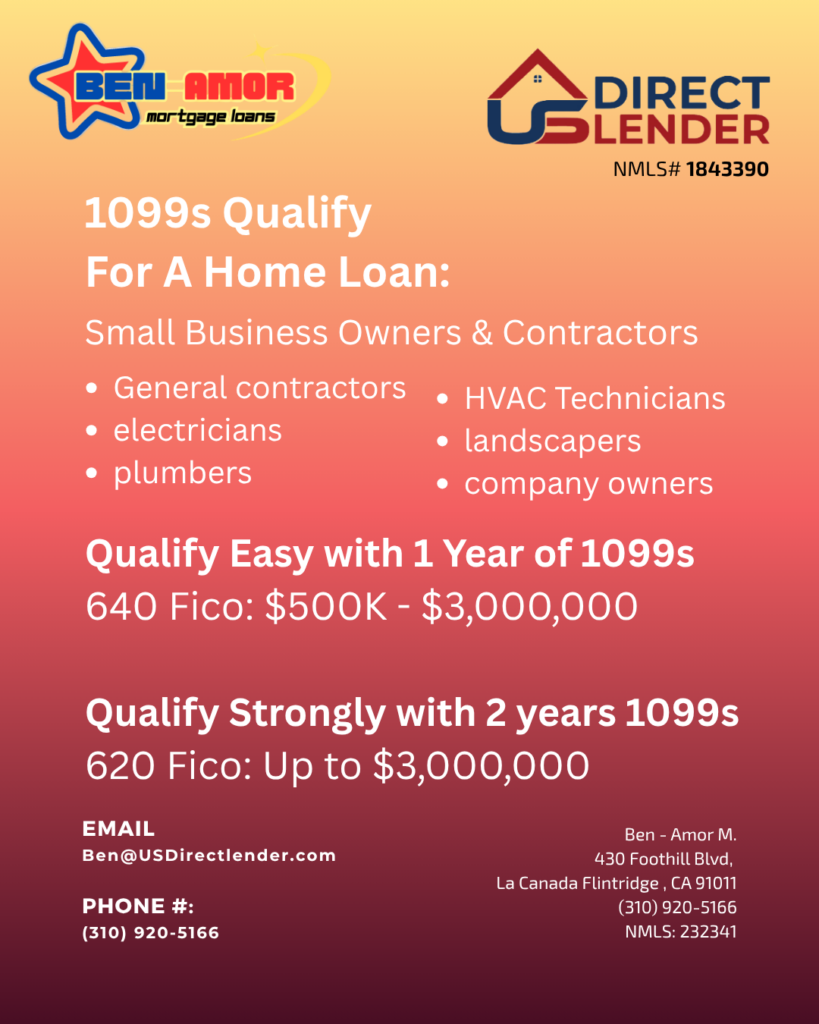
A 1099 mortgage program allows qualified borrowers to use their 1099 earnings rather than traditional tax-return calculations.
Instead of focusing primarily on taxable income, lenders may review:
- One or two years of 1099 forms
- Business bank statements
- Personal bank statements
- Income consistency
These programs are designed for borrowers who have strong cash flow but significant business deductions.
In many cases, a borrower may qualify for a larger loan amount compared to a traditional tax-return-based mortgage.
Example Scenario
Consider two borrowers who each earn approximately $120,000 annually.
Borrower A: Traditional Qualification
- Gross income: $120,000
- Business deductions: $50,000
- Taxable income: $70,000
A traditional lender may qualify the borrower using approximately $70,000 of annual income.
Borrower B: 1099 Program
- Annual 1099 income: $120,000
- Consistent income history
- Strong bank deposits
A lender offering a 1099 mortgage program may qualify the borrower using a significantly higher percentage of the actual earned income.
The result could be increased purchasing power and access to homes that might otherwise be out of reach.
Who Benefits Most From 1099 Loans?
1099 mortgage programs are often a strong fit for:
- Independent contractors
- Real estate professionals
- Sales representatives
- Gig economy workers
- Consultants
- Small business owners
- Self-employed professionals with substantial write-offs
These borrowers frequently have strong earning potential but may not fit conventional underwriting guidelines.
Preparing to Apply
Self-employed borrowers can improve their chances of approval by preparing documentation early.
Helpful steps include:
- Keep accurate records of income and expenses.
- Maintain separate business and personal accounts.
- Avoid large unexplained bank deposits.
- File taxes consistently and on time.
- Work with a mortgage professional experienced in self-employed lending.
The more organized the documentation, the smoother the approval process is likely to be.
Final Thoughts
Receiving 1099 income should not prevent someone from achieving homeownership. While qualifying may involve additional documentation compared to traditional W-2 borrowers, today’s mortgage market offers multiple solutions specifically designed for self-employed individuals.
Whether through conventional financing, bank statement programs, profit-and-loss statement loans, or specialized 1099 mortgage programs, borrowers have more options than ever before.
For many self-employed professionals, the key is working with a lender who understands how to evaluate non-traditional income and identify the loan program that best reflects their true earning power. With the right strategy and preparation, a 1099 borrower can successfully qualify for a mortgage and achieve their homeownership goals.


